

Understanding the basics of your home’s electrical system is a valuable skill for any homeowner. I know it can seem complicated with all the wires and circuits but it is not as mysterious as it first appears. When we talk about household lighting circuit basics, we are really discussing the fundamental way electricity flows to power the lights in our living spaces. This knowledge helps us perform simple repairs and also understand when to call in an expert.
I believe that having a grasp of these core concepts can make you feel more confident about your home. It helps you recognize potential issues before they become major problems. My goal here is to demystify these essential circuits so you feel more informed and prepared. I want to help you see how electricity brings light into your home every single day.
Safety is always paramount with electricity. We will touch on the crucial safety elements and I will highlight when it is best to leave things to the professionals. Learning about your lighting circuits means more than just fixing a flickering bulb. It is about understanding the safety features designed to protect your home and family.
Understanding the Core Components of Your Lighting Circuit
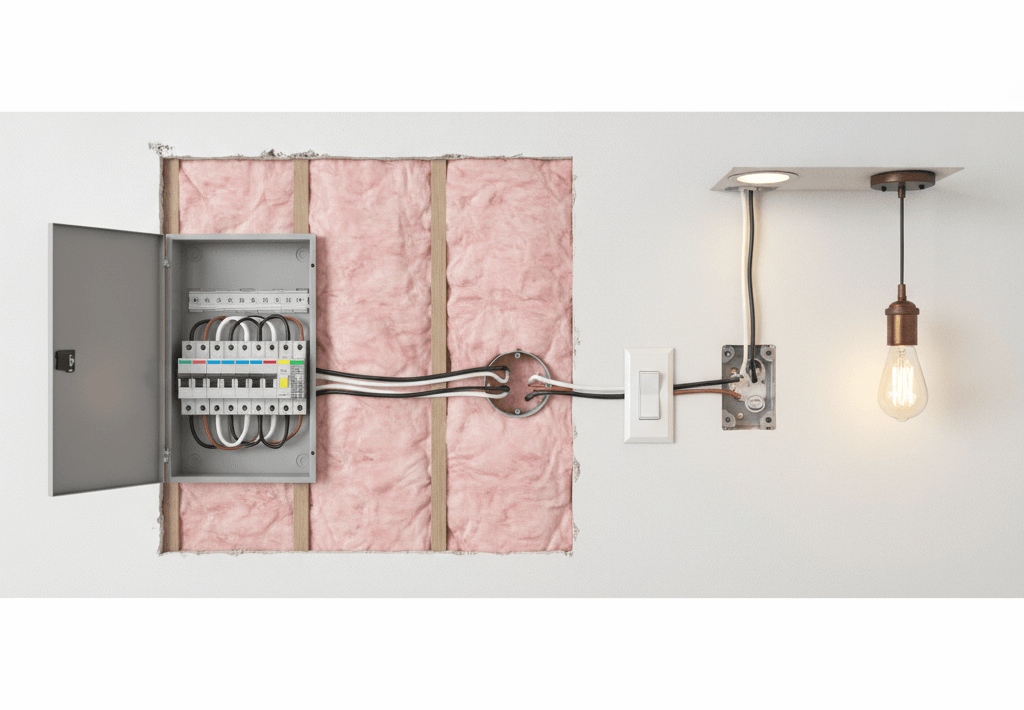
Every lighting fixture in your home relies on an electrical circuit. Think of a circuit as a continuous loop or path that electricity travels. This path starts at your home’s main electrical panel, flows through wires to your light switch and then to the light fixture itself. Finally, it returns to the panel completing the loop.
Each circuit contains several key components. The power source comes from your electrical utility and enters your home at the service panel. This panel houses circuit breakers which are essential safety devices. Wires carry the electricity throughout your walls and ceilings. Switches control the flow of power to your lights. The light bulb or fixture is the load that uses the electricity to produce light.
I often tell people that visualizing this path makes it easier to understand how everything connects. Imagine electricity as water flowing through pipes. The pipes are your wires and the valves are your switches. The sink is your light fixture. If any part of this system is broken, the water stops flowing. Electricity works in a similar way.
The Path of Electricity Through Your Home
The journey of electricity begins at your utility pole and then comes into your home. Inside your main electrical panel, a main breaker protects the entire house. From there, individual circuit breakers protect specific circuits, like those for your lights. When you flip a light switch, you are closing a part of that circuit, allowing electricity to flow from the breaker, through the hot wire, to the light fixture.
Once the electricity powers the light, it completes its work and returns to the electrical panel through the neutral wire. This continuous flow is what lights up your rooms. A ground wire also runs alongside the hot and neutral wires. This third wire provides an extra layer of safety. It offers a direct path for electricity to go safely into the earth if there is a fault.
This grounding system is a critical safety feature. It prevents dangerous electrical shocks and reduces the risk of electrical fires. It is designed to quickly trip a circuit breaker if an unintended path for electricity develops. This stops the flow of current protecting you and your home.
Common Household Wiring: Parallel Circuits for Lighting
When it comes to household lighting, parallel circuits are the industry standard and for good reason. In a parallel circuit, each light fixture is connected across the same two points in the circuit. This means each light receives the full voltage from the power source independently. If one light bulb burns out, the other lights on the same circuit will continue to function normally. This design is highly practical and efficient for residential use.
I cannot stress enough how important this parallel design is for daily convenience. Imagine if your entire living room went dark just because one bulb failed. That would be frustrating for sure. Parallel wiring prevents this common annoyance. It ensures consistent illumination across all fixtures on a single circuit.
Series circuits, in contrast, connect components one after another. If you have ever seen old Christmas lights where one bulb going out made the whole string fail, that was a series circuit. This type of wiring is generally unsuitable for household lighting. It is because each light would share the voltage and if one fails, the entire circuit breaks.
Advantages of Parallel Wiring in Your Home
The primary benefit of parallel wiring for lighting is its reliability. Each light operates independently, so a fault in one does not affect the others. This makes troubleshooting much simpler. If a light is not working, you usually only need to check that specific fixture or bulb rather than the whole circuit.
Another advantage is that all lights on a parallel circuit receive the same voltage. This ensures they operate at their intended brightness. In a series circuit, adding more lights would dim them all because the voltage would be divided. Parallel wiring prevents this issue, providing consistent and bright lighting throughout your home.
This uniform power distribution helps extend the life of your bulbs and fixtures. It ensures they are not overstressed or underpowered. This makes parallel circuits a cornerstone of modern residential electrical design. It offers both safety and practicality.
Key Electrical Components in Lighting Circuits
Beyond the basic wires, several other electrical components are crucial for your lighting circuits. Switches are perhaps the most common component we interact with daily. A standard single-pole switch simply turns a light or group of lights on and off from one location. These are found in almost every room.
For larger rooms or hallways, you might encounter three-way switches. These allow you to control a single light fixture from two different locations. For instance, a switch at the top and bottom of a staircase. There are also four-way switches which permit control from three or more locations. Understanding how these switches work is important if you are trying to diagnose a lighting issue.
Light fixtures themselves also vary widely in design and installation. From simple screw-in bulb sockets to complex recessed lighting systems, each fixture serves as the final point where electricity is converted into light. I always advise checking the manufacturer’s instructions for any specific fixture you are installing or repairing.
The Vital Role of Wires in the Circuit
In every lighting circuit, you will typically find three types of wires. These are the hot wire, the neutral wire and the ground wire. Each plays a distinct and important role. The hot wire, usually black or red, carries the electricity from the breaker panel to the device. This is the wire that is “live” or “energized” when the circuit is on.
The neutral wire, typically white, completes the circuit by carrying the electricity back to the breaker panel. It maintains a balanced electrical system. Without a proper neutral path, the circuit cannot function correctly. The ground wire, usually green or bare copper, is the safety net. It provides a safe path for electricity to flow in case of a fault. This prevents electrical shock and fire hazards. It is not meant to carry current during normal operation.
I cannot overstate the importance of correctly identifying these wires before doing any electrical work. Always use a voltage tester to confirm that the power is off before handling any wires. Getting them mixed up can lead to serious safety risks or damage to your electrical system.
Safety First: Circuit Breakers and Grounding
Electrical safety is not something to take lightly. The circuit breaker is your home’s first line of defense against electrical hazards. These devices are designed to automatically trip or shut off the power to a circuit if they detect an overload or a short circuit. An overload occurs when too much current flows through the wires, which can cause them to overheat and potentially start a fire. A short circuit happens when a hot wire directly contacts a neutral or ground wire, causing a sudden surge of current.
I always make sure homeowners understand that a tripped breaker is a warning sign. It means something is wrong. Do not simply reset the breaker without investigating the cause. It could be a faulty appliance, too many devices plugged into one outlet or a problem within the wiring itself. Ignoring these signals can lead to more serious issues.
Grounding is another fundamental safety measure. The ground wire offers a low-resistance path for electricity to travel directly to the earth in the event of an electrical fault. This path protects you from electric shock if an appliance or fixture malfunctions and its metal casing becomes energized. It effectively drains away dangerous current before it can harm anyone.
What Happens During an Electrical Fault?
When an electrical fault occurs, such as a short circuit or an overload, the circuit breaker instantly detects the abnormal current flow. It quickly “trips” or opens the circuit, stopping the electricity before it can cause damage or injury. This quick response is why circuit breakers are so essential. They protect your wiring, appliances and most importantly, your family.
If a breaker trips frequently, it is a clear indication of an ongoing problem. It might be time to reduce the load on that circuit or have a qualified electrician inspect your wiring. Never ignore recurring tripped breakers. They are performing their intended safety function and they are trying to tell you something needs attention.
Proper grounding ensures that stray electrical current has a safe route away from your living space. This minimizes the risk of electrocution. It is a silent protector working constantly in the background. Without it, you would not have the same level of protection.
Basic Tools and Materials for Simple Lighting Tasks
For simple household lighting tasks, having the right tools makes a big difference and ensures safety. I always keep a few key items in my toolbox. First, a non-contact voltage tester is absolutely essential. This device allows you to check if wires are live without touching them directly. It is a lifesaver for safety.
You will also need a good set of screwdrivers, both Phillips and flathead, for removing switch plates and opening fixture housings. Wire strippers and cutters are helpful for preparing wires if you are replacing a fixture or switch. Electrical tape is useful for insulating connections, although wire nuts are typically used for joining wires. A pair of needle-nose pliers can also be handy for bending wires into loops for terminal connections.
Remember that the most important tool is your brain. Always think through each step and prioritize safety. Make sure the power is off at the breaker before you begin any work. It is easy to get distracted but taking that extra moment to double-check can prevent accidents.
Essential Supplies for Light Work
- Non-contact voltage tester: To confirm power is off before touching wires.
- Screwdrivers: Both Phillips and flathead for various screws.
- Wire strippers/cutters: For preparing and trimming electrical wires.
- Electrical tape: For insulating connections and securing wires.
- Wire nuts: Used to securely join multiple wires together.
- New light fixture or switch: The component you are replacing.
When to Call a Professional Electrician
While understanding household lighting circuit basics can empower you to handle minor tasks, it is crucial to recognize your limitations. Electrical work can be dangerous if not done correctly. I always advise calling a professional electrician when you are unsure or when the task involves more than a simple swap. Faulty wiring can lead to serious hazards including fires and electrocution. Do not take unnecessary risks with your home’s electrical system. It is simply not worth it.
Any flickering lights that are not solved by a new bulb, frequent circuit breaker trips, or outlets that do not work should be investigated by an expert. If you smell burning, hear buzzing sounds from switches or outlets, or notice warm switch plates, these are urgent signs that demand professional attention. These symptoms often indicate deeper issues that require specialized knowledge and tools to diagnose and repair safely. Knowing how to find a good electrician is an essential part of responsible homeownership. They bring experience and training to handle complex electrical problems.
Beyond troubleshooting existing problems, a licensed electrician is indispensable for new installations or major upgrades. Adding new circuits, installing heavy-duty appliances that require dedicated circuits or upgrading your electrical panel are all jobs for professionals. They ensure that all work meets local electrical codes and safety standards. This protects your home and maintains its value.
Demystifying Your Home’s Lighting: A Final Word
I hope this journey through household lighting circuit basics has been enlightening and informative. We have covered the fundamental components that power your lights, from the electrical panel to the switches and fixtures. Understanding the continuous loop of electricity and the essential role of parallel circuits helps us appreciate the intricate design behind our everyday illumination. We also discussed the vital safety mechanisms, like circuit breakers and grounding, that protect our homes from electrical faults. I want every homeowner to feel a greater sense of confidence in understanding the electricity around them.
I believe that knowing these basics is incredibly valuable. It helps you recognize when a simple bulb change is all that is needed or when a more serious issue might be brewing. Always prioritize safety in any electrical task. If you are ever in doubt about the safety of an electrical repair or installation, please do not hesitate to reach out to a qualified professional. They have the expertise to keep your home safe and well-lit. Empower yourself with knowledge but always respect the power of electricity.
My hope is that you now feel better equipped to approach your home’s electrical system with a clearer understanding. Do not be afraid to tackle minor tasks like replacing a light switch or fixture, but always remember to turn off the power at the breaker first. For anything more complex, trust the experts. Your safety and the well-being of your home are always the most important things to consider.


